
Home | Anecdotes | Articles | Digital Products | Icebreakers | Programs | Quotations
Bicton Park Botanical Gardens

The Botanical Gardens have their roots in the early 18th century, but Bicton itself dates back more than 1300 years. It was originally called Beoccatun, meaning the hamlet belonging to Beocca, a Saxon chieftain who settled in the forest on the west bank of the River Otter, which was much wider then than it is now.
Bicton Park Botanical Gardens is home to many rare plants with origins from all parts of the world, including one of the finest collections of trees in Britain.
This Heritage garden is maintained by a team of dedicated gardeners who look after and tend the different areas so that you can enjoy them to the fullest.
The 63 acres of land and gardens keep me coming back time after time as I see them progress through the year and change with the seasons.
The Italian Garden

A stunning blend of formality and colour, the Italian Garden is Bicton’s world-renowned centrepiece. It is almost 300 years old and still provides the park’s most famous view, across vast terraced lawns to a tiered fountain that stands directly in line with a distant obelisk.
The stone obelisk, framed by a sunken avenue excavated by French prisoners of war, was built on a hill outside the park in 1743 to form a focal point for the garden's central axis. In the foreground, smaller fountains are ringed with flowerbeds. Specimen trees, planted urns, and elegant statues complete a memorable panorama.
The Italian Garden, so-named because its style originated in Renaissance Italy, was inspired by the French designer Andre Le Nôtre (1613–1700), who created the gardens at Versailles for Louis XI. Le Notre worked on at least one commission in London, and it has been suggested that he visited Bicton to draw the plan that Henry Rolle used when he laid out the Italian Garden in c.1735.
The American & Stream Gardens
Some of the loveliest trees in the park can be found in the American Garden. This area of the park, established in the 1830s, also has a selection of non-American plants.
These include the infamous Chinese handkerchief tree, whose large white bracts flutter among its foliage in May.
The area also features some of the park's most colourful trees and shrubs, along with moisture-loving plants such as Primulas, Hostas and the Giant Gunnera.

Sequoias (Sequoia sempervirons - coast redwood) are the tallest tree species. They are native to the fog belt of Northern California and southern Oregon.
They are stunningly tall and give a feeling of 'inverted' vertigo when you look up.
The bark has a spongy texture, which helps to protect the trees from wildfires.
Did you know that there are more sequoias in the UK than in the whole of the United States?


The Mediterranean & Rose Gardens

Drought-tolerant plants, including phormiums and cordylines, grow on a sunny slope below the scented delights of the early 19th-century Rose Garden.
The Fernery & Shell House

Exotic tree ferns make a primaeval-looking rocky glade created at the start of the Victorian ‘fern fever’ era. The Flint Shell House contains a unique and special collection of seashells from around the world. Footpaths weave through a maze of ferns to access the area.

St Mary's Church

The Church of St Mary has been a key feature of the Bicton landscape since 1850. It was built to honour Lady Louisa’s affection for her late husband, who died eight years earlier. On the gables of each stained-glass window carved in Bath Stone are the kings and Queens of England, from Edward I to Queen Victoria.
The Pinetum & Arboretum

Bicton has long been famed for its magnificent trees — over 1000 of them representing 300 species, many of which are endangered in the wild. We are proud to have 25 champion trees — the tallest and/or largest of their kind in the British Isles. At 41m (134ft), our champion Grecian fir is the tallest ever recorded. Bicton’s internationally acclaimed Pinetum is devoted to the virtues of conifers, whose stately forms add a dramatic dimension to the parkland.
The Hermitage Garden

A place of almost perfect peace, the Hermitage Garden is named after the romantic 19th-century bower house where Lord John and Lady Louisa Rolle retreated from the outside world during the last years of his Lordship’s life. This far corner of the park contains a notable collection of dwarf conifers and heathers. Nearby, colourful camellias and rhododendrons stretch beyond the Hermitage into the wooded valley of the Secret Garden.
The Hermitage itself, a Victorian summerhouse constructed in 1839 and restored in 2006, is an outstanding example of rural craftsmanship. Its walls are clad with thousands of ‘fish-scale’ wooden shingles, and the floor consists entirely of deer bones, pushed into the earth with their ‘knuckle’ ends uppermost.
Countryside Museum

The Countryside Museum and Lister Engine display is well worth visiting. They feature a huge collection of exhibits that mirror the changes to village life, farming, horticulture, social history and rural crafts during the first half of the 20th century.
The Palm House

The magnificent Palm House is one of the world’s most beautiful garden buildings. Dating from c.1825, it is about 20 years older than the Palm House at the Royal Botanic Gardens at Kew. Four additional glasshouses each provide specific conditions for growing a diverse range of plants.
Bicton Railway
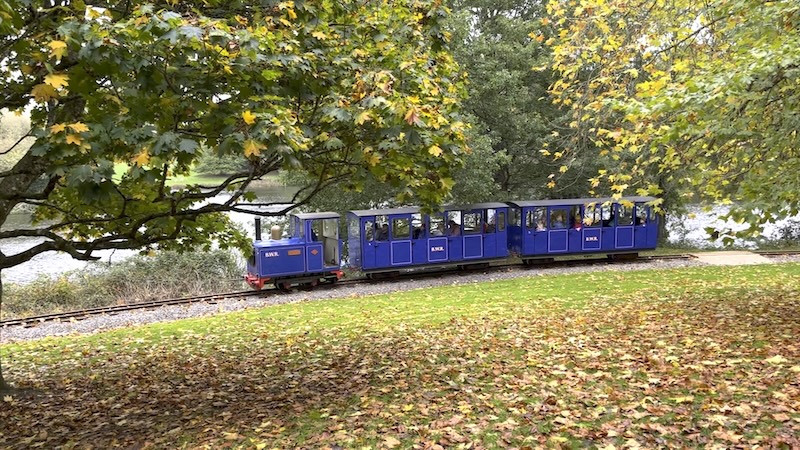
The Bicton Woodland Railway (BWR), not to be confused with the Great Western Railway (GWR), was developed in the early 1960s as an additional attraction within the gardens.
The longest-established 18-inch gauge railway runs every day except for winter Fridays, Christmas and Boxing Day.
A scenic ride around the park on the Bicton Woodland Railway is a treat for children and grown-ups alike. It’s also something special for railway enthusiasts because BWR runs on the only 18-inch (457 mm) gauge leisure line left in Britain. The train operates all year, making regular 25-minute trips, for which there is a small extra charge.
The train departs from Bicton Station and winds its way through the Pinetum, home to many of our champion trees, to Hermitage Station at the far end of the park. From there, it takes you back along the banks of the Great Lake to complete its journey of around 1.5 miles (2.4 km).
Custom-built for Bicton Park in 2000, the replica tank engine, Sir Walter Raleigh, was named after the 16th-century adventurer who was born near Bicton. The 5.5-tonne loco hauls up to four 24-seater coaches, all of which are roofed to keep the passengers dry on rainy days.
Location
Bicton Park's entrance is about 4km south of Newton Poppleford, on the west side of the B3178, which runs from Newton Poppleford to Budleigh Salterton.
Map
You can also view the map on what3words:what3words defines any global 3x3 metre location using only three words!
Acknowledgements
My thanks to Bicton Parks management for their assistance in writing this article.
Originally published by PeakD
These posts are about places that I have visited. All the photos were taken by me, though not necessarily on the same visit.
🍯 Make a donation to the Learning Pages project