
Home | Anecdotes | Articles | Digital Products | Icebreakers | Programs | Quotations
'Ancient' Computer Assisted Learning
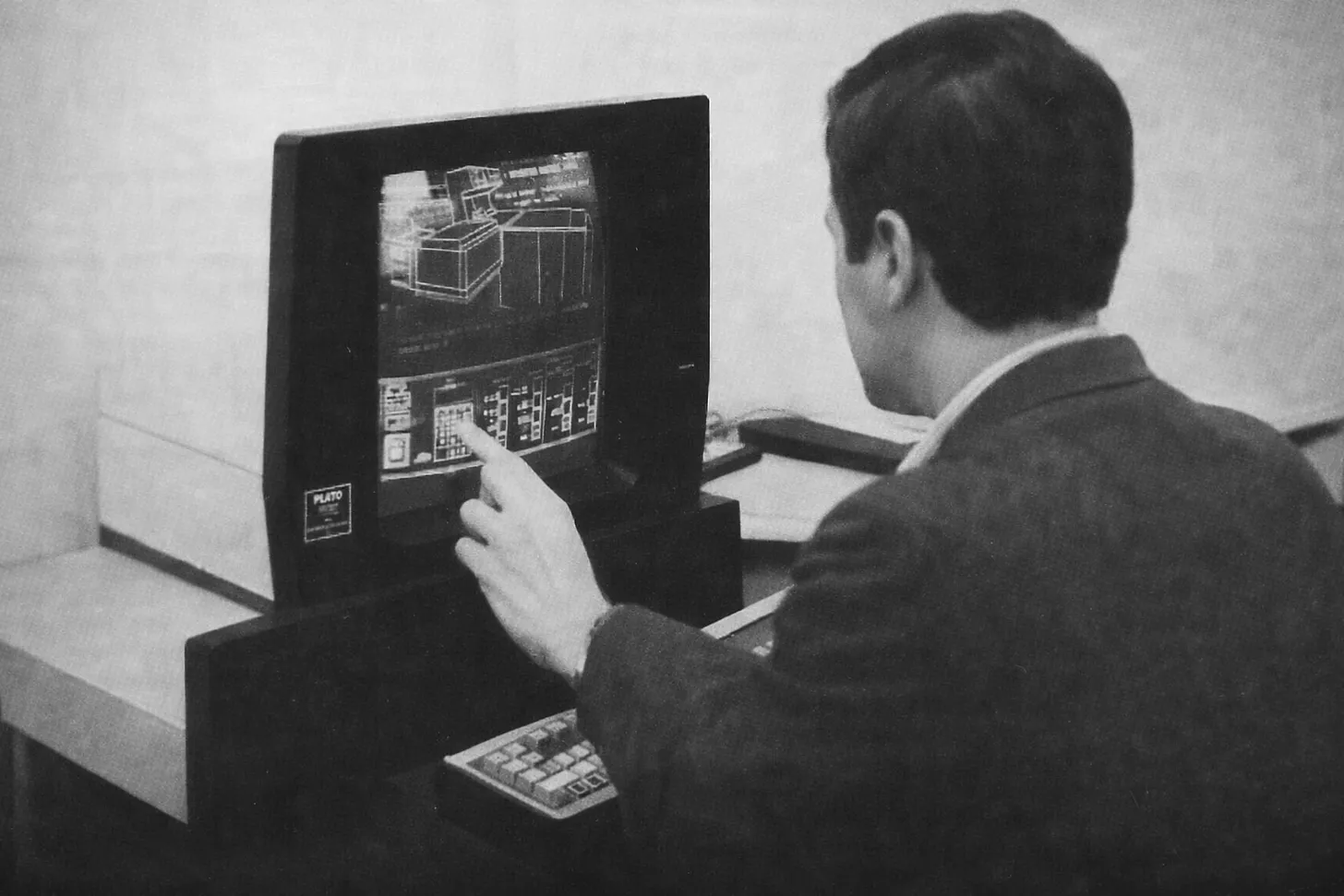
Image generated by ChatGPT from an original photograph
PLATO (Programmed Logic for Automatic Teaching Operations) was a computer application dedicated to education and training. It was applied internationally to solve a wide range of training problems.
Typical examples of training included remedial education for basic skills, engineering logic testing, pre-simulator coaching for airline pilots, sales training and a range of office skills from typing to financial management.
The image above shows a student learning how to operate Xerox’s 9200 photocopier - a high-volume copier originally introduced in the mid-1970s as part of Xerox’s line of large duplicators. It was designed for print shops and large office reprographic departments. Nashua developed the program to teach its own salespeople.
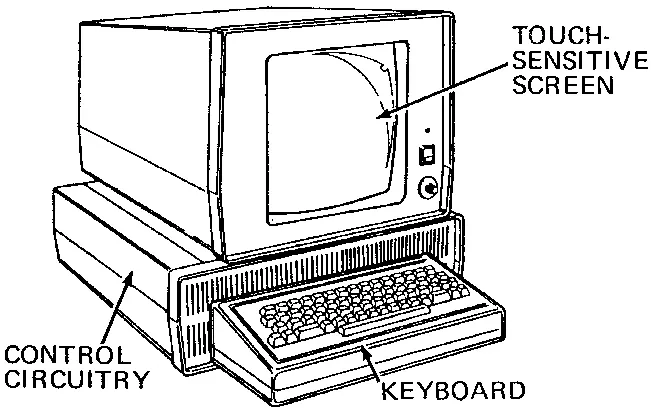
The terminal had an interactive graphics display capability and incorporated a touch-sensitive display panel, an electronic keyboard, and built-in microprocessor logic control.
Ancillary devices such as hard copy units and audio units could be attached. The service was provided by a Cyber computer operating in Brussels, and all European users communicated with Brussels through telephone links.
Lessons could use these features in any combination. For example, a music lesson could show musical notes on the screen, play the notes on an attached audio device, and ask the student to respond to a question by touching the screen.
The screen presented information as text or line drawings. It was a high-resolution cathode-ray tube (CRT), with a viewing area of 8.5 inches by 8.5 inches (22 centimetres by 22 centimetres) on the front of the terminal.
The screen consisted of a grid of 512 dots by 512 dots (pixels), which lit in any combination to form characters, lines, curves, and figures.
The computer could fit 32 lines of alphanumeric characters on the screen with 64 characters per line.
When the user pressed a character key on the keyboard, the computer processed the individual keypress and displayed an appropriate character, as determined by the current lesson.
The terminal displayed 170 characters per second, erased 600 characters per second, or the whole screen at once. The terminal also drew and erased lines at speeds up to 60 lines per second.
The primary input to the PLATO system was the PLATO keyboard. The keyboard had character keys, much like a typewriter, and it had function keys, some of which affected lesson execution and some of which modified the character keys.
For example, the student could often receive help in a lesson by using the HELP key, or a mathematics student could type numbers with exponents (superscript) by using the SUPER key.
By using the SHIFT key, the uppercase character keys and the uppercase function keys became available. In addition to these, other characters and functions were available with the ACCESS key.
The application had two major features: computer-assisted instruction (CAI) and computer-managed Instruction (CMI).
CAI provided high-quality individualised instruction directly through the terminal. Its easy-to-use, yet powerful authoring language offered the course designer (who needed no previous computer experience) sophisticated graphics, gave the student supporting feedback, and a range of different methods for interaction, including response by simply touching the screen.
CMI provided a comprehensive instructional control system designed to maximise the effectiveness of individual learning and the measurement/enhancement of the effectiveness of training courses.
Sophisticated testing and recording capabilities allowed the system to assess individual students and assign the most suitable learning resources. It also provided instructors and training managers with analysis of individual or group performance profiles and feedback on the course’s effectiveness.
CMI designed the system to be instructor-independent, allowing students to train efficiently at any time on their own. At the same time, it gave the instructor the earliest possible identification of weak students or weak course material.
The computerised marking and record keeping freed expert instructors from unproductive clerical tasks, and, at the same time, the resulting database could be incorporated into overall assessment schemes or function as a skills inventory for Manpower Planning.
Module Management
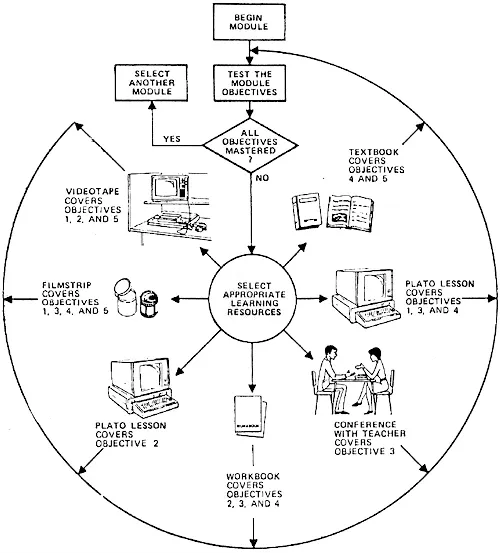
This flowchart illustrates how the same objectives can be achieved with different media.
PLATO’s History
1959-1960
A research project was initiated in 1959 at the Co-ordinated Science Laboratory, University of Illinois, Urbana, Illinois, under the direction of Dr Donald L. Bitzer, to investigate the use of a computer to assist instruction in technical subjects.
1961–1964
PLATO ran on Ivy computers, which had very limited terminals. It focused on programmed learning and basic instructional exercises.
1965
PLATO transitioned to Control Data Corporation’s mainframes, enabling increased user access and improved graphics.
Late 1960s
The University of Illinois organised the Computer-Based Education Research Laboratory (CERL), and the PLATO project moved to a new laboratory.
Plasma display terminals were introduced (early touchscreen technology), and bitmapped graphics enabled diagrams, charts, and interactive lessons.
In 1967, Control Data and CERL had engaged in a joint development effort which produced the first economical, large-scale, computer-based education system.
1970s
The TUTOR Language, originated by Paul Tenczar and other CERL staff members, had evolved to the CONTROL DATA PLATO author language, which supported the production of PLATO lessons.
PLATO became widely installed in schools, universities, and military training centres.
Networking of terminals allowed multiple users to connect simultaneously.
Early forms of online communication included notes, files (message boards), chat, and email.
In 1973, multiplayer games were developed on PLATO, e.g., Empire and Airfight.
Early concepts of online multiplayer and social interaction.
In the late 1970s, PLATO reached its peak with over 100,000 users connected worldwide. It was also a major platform for educational software and research in human-computer interaction.
1980s
PLATO’s decline began because of:
-
High costs of mainframes and terminals.
-
Personal computers became cheaper and more versatile.
-
Many institutions migrated away from PLATO.
Legacy and Influence
The PLATO systems were largely retired during the 1900s and 2000s, but their concepts, decades ahead of the web, influenced :
-
Online forums.
-
Instant messaging.
-
Email.
-
Multiplayer online games.
-
Social computing.
-
Networked learning.
-
e-learning platforms.
🍯 Make a donation